Pricing engraved tumblers for craft fairs is where a lot of new laser engraving businesses quietly lose money. If you want to know how to price engraved tumblers without guessing, start by calculating your real cost per cup and then build in enough profit to cover your time, booth fees, and mistakes.
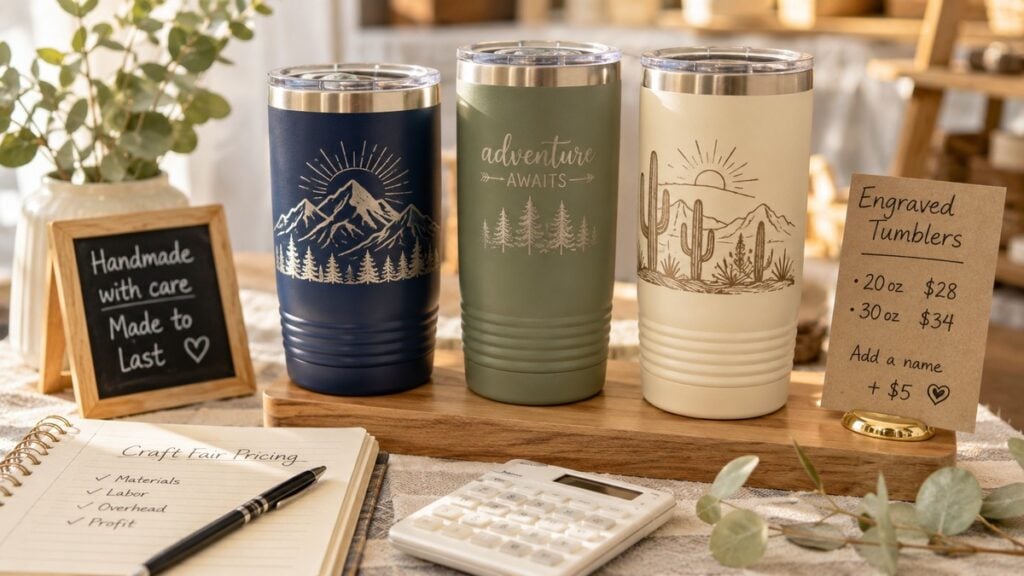
Table of Contents
They sell cups. They stay busy. They come home tired. Then they realize they made about enough profit to buy dinner and a pack of shipping labels. Fantastic. Another small business learning accounting the hard way.
The good news is pricing tumblers is not magic. It is math, market awareness, and not being afraid to charge like a business instead of a hobby with a folding table.
This guide walks through how to price engraved tumblers for craft fairs using real costs, target profit, local market checks, and simple upsells that increase your average order value.
Start With Your Real Cost Per Tumbler
Before you set a price, you need to know what each engraved tumbler actually costs you.
Do not use only the blank tumbler cost. That is rookie math. Your real cost includes materials, consumables, labor, booth costs, payment fees, and a little wear and tear on your equipment.
A simple formula looks like this:
True Cost Per Tumbler = Blank + Consumables + Labor + Booth Cost Per Item + Payment Fees
Here is what that usually includes:
| Cost Item | Example Cost | Notes |
|---|---|---|
| Blank tumbler | $6.00-$12.00 | Depends on size, quality, and supplier |
| Masking/tape/wipes | $0.25-$0.75 | Easy to forget, but it adds up |
| Laser time/labor | $1.00-$5.00 | Include prep, alignment, engraving, cleanup |
| Booth fee per item | $1.00-$5.00 | Divide booth cost by expected sales |
| Card processing | 2.6% + 15¢ | Common in-person Square rate |
| Packaging | $0.50-$3.00 | Bag, box, tissue, care card, etc. |
Let’s say your 20 oz powder-coated tumbler costs $8.00. You spend about $0.50 on tape and cleanup supplies. It takes you 6 minutes total to prep, engrave, inspect, and package it. If you value your time at $30 per hour, that is $3.00 in labor.
Now add booth cost. If the market booth is $100 and you expect to sell 40 items, that is $2.50 per item.
Before card fees, your cost is:
$8.00 + $0.50 + $3.00 + $2.50 = $14.00
That means selling it for $18 is not “making $10.” It is barely keeping the lights on. Math is rude like that.
Use a Target Profit Margin
A healthy craft fair tumbler price usually needs to land somewhere around a 50% to 70% gross margin, depending on the blank, design, customization, and market.
Gross margin means the percentage of the sale price left after direct costs.
The formula:
Gross Margin = (Selling Price – Cost) ÷ Selling Price
Example:
If your real cost is $14 and you sell the tumbler for $30:
($30 – $14) ÷ $30 = 53.3% gross margin
That is workable.
If you sell that same tumbler for $22:
($22 – $14) ÷ $22 = 36.4% gross margin
That is weak for handmade retail, especially when you still have taxes, slow days, damaged blanks, unsold inventory, and the occasional customer who treats your booth like a free museum. SCORE also offers small business templates and mentoring resources that can help sellers think through pricing and break-even points.
How to Price Engraved Tumblers: Suggested Craft Fair Prices
These numbers are not carved into stone, despite the laser engraving vibes. Use them as a starting point.
| Tumbler Type | Estimated True Cost | Suggested Retail Price | Estimated Gross Margin |
|---|---|---|---|
| 20 oz stainless tumbler, simple design | $10-$13 | $25-$30 | 50%-60% |
| 20 oz powder-coated tumbler | $12-$15 | $30-$35 | 55%-60% |
| 30 oz powder-coated tumbler | $14-$18 | $35-$45 | 55%-65% |
| Personalized name tumbler | $15-$20 | $40-$50 | 55%-65% |
| Premium/custom artwork tumbler | $20-$30 | $55-$75+ | 55%-70% |
If you are just starting, a clean pricing ladder works well:
- Basic stock design: $28-$32
- Personalized name/design: $38-$45
- Custom artwork or logo: $55+
- Bulk orders: quoted separately
Simple sells. Confused customers walk away.
Do Not Price Like Walmart
You are not competing with a $9 tumbler from a big box store. You are selling a finished, personalized, giftable product made by a real person.
At a craft fair, people are not just buying a cup. They are buying:
- a gift
- a personal design
- a local maker story
- convenience
- customization
- something they can hold before buying
If your booth looks good and your designs are strong, customers will pay more than online bargain-bin prices.
This is where a lot of sellers choke. They think, “I would not pay $45 for a tumbler.” Maybe not. You are not always your customer. Your customer might be buying a teacher gift, a bridesmaid gift, a Father’s Day gift, or a “my husband is impossible to shop for” gift. That last category should honestly be its own federal tax bracket.
Research Your Local Market
Before locking in prices, do some basic market research.
Walk the fair. Look at other engraved tumbler booths. Do not be weird about it. Just observe.
Pay attention to:
- What sizes they sell
- Whether they offer personalization
- Their price range
- How professional their display looks
- Whether customers are buying or just nodding politely
- Which designs people pick up
Also check Etsy and Facebook Marketplace to see what similar tumblers are listed for, but do not blindly copy those prices. Online pricing often excludes the value of immediate pickup, local connection, and in-person customization.
Your local market matters. A $45 tumbler may be easy in one market and too high in another. The only way to know is to test.
Use Three Pricing Models
There are three common ways to price engraved tumblers. Use all three as a sanity check.
1. Cost-Plus Pricing
This is the easiest method.
You calculate your true cost, then add your desired profit.
Example:
- True cost: $14
- Desired profit: $18
- Selling price: $32
This is a good starting point for standard tumblers.
2. Market-Based Pricing
This means pricing based on what similar products sell for in your market.
If other sellers are charging $35 for personalized 20 oz tumblers and you are at $22, you are probably leaving money on the table. If you are at $55 and your designs look like they were made during a power outage, you may have a different problem.
3. Value-Based Pricing
This is where better money lives.
Value-based pricing is used when the customer sees extra personal value in the product.
Examples:
- company logo tumblers
- wedding party gifts
- memorial designs
- sports team gifts
- teacher appreciation gifts
- custom names
- rush orders
These should cost more because they solve a specific problem for the buyer.
A personalized gift with a name, date, logo, or inside joke is worth more than a generic mountain scene cup. Charge accordingly.
Add Easy Upsells
Upsells are where craft fair profits get interesting.
You do not need to be pushy. Just offer clear options.
Good tumbler upsells include:
| Upsell | Suggested Add-On Price |
|---|---|
| Add a name | $8-$12 |
| Add design to the back | $10-$15 |
| Gift box | $5-$8 |
| Rush customization | $10-$20 |
| Matching second tumbler | 10%-15% off second item |
| Bulk order quote | Custom pricing |
A customer buying one $32 tumbler might easily become a $45 sale with a name and gift box.
If you sell 40 tumblers in a day and raise your average order by $8, that is $320 more revenue without needing more booth traffic. Imagine that: money from math instead of begging the algorithm for mercy.
Build a Simple Craft Fair Price Board
Do not make people ask the price on everything. Some will. Most will not. They will just leave.
Use a clean sign like this:
Engraved Tumblers
- Stock designs: $30
- Personalized name tumblers: $40
- Premium/custom designs: starting at $55
- Gift box add-on: $6
- Bulk orders available
This does three things:
- It pre-qualifies buyers.
- It reduces awkward price questions.
- It makes your booth feel more professional.
If every price is hidden, shoppers assume one of two things: it is expensive, or you are making it up as you go. Neither helps.
Do Not Forget Sales Tax
Sales tax rules vary by state and sometimes by city or county. If you sell in person at markets, check your state’s requirements for seller permits, taxable goods, filing frequency, and temporary event rules. For general small business guidance, the U.S. Small Business Administration has resources on business planning and managing costs.
Do not treat sales tax like a cute little optional side quest. States are not known for their sense of humor.
A practical approach is to decide whether your displayed price includes tax or whether tax is added at checkout. At craft fairs, many sellers prefer tax-included pricing because it keeps checkout fast.
Example:
- Sign says: Tumblers $35 tax included
- Customer pays $35
- You back out the tax later in your bookkeeping
Just make sure your payment app and bookkeeping match what you are doing.
Common Pricing Mistakes
Charging Only Based on Blank Cost
If the blank cost $8, that does not mean $20 is automatically profitable. Add your time, booth fee, tools, packaging, failed blanks, and fees.
Not Paying Yourself
If your pricing only works when your labor is free, the business is broken. That is not a business model. That is volunteering with power tools.
Over-Discounting
Discounts can help move slow inventory, but constant discounts train customers to wait. Offer bundles instead.
Example:
- Bad: “Everything 20% off.”
- Better: “Buy two, save $5.”
Pricing Every Design the Same
Simple stock designs and custom logo jobs should not cost the same. One is repeatable. The other eats your time and your will to live.
Ignoring Presentation
A $35 tumbler in a cheap plastic bin feels expensive. A $35 tumbler displayed cleanly with good signage, care cards, and gift options feels reasonable.
Presentation affects price tolerance.
Quick Pricing Examples
Example 1: Simple Stock Tumbler
- Blank: $7.50
- Supplies: $0.50
- Labor: $2.50
- Booth allocation: $2.50
- True cost: $13.00
Suggested price: $30
Estimated gross profit: $17
Example 2: Personalized Name Tumbler
- Blank: $8.50
- Supplies: $0.75
- Labor: $4.50
- Booth allocation: $2.50
- True cost: $16.25
Suggested price: $40-$45
Estimated gross profit at $42: $25.75
Example 3: Custom Logo Tumbler
- Blank: $10.00
- Supplies: $1.00
- Labor/setup: $12.00
- Booth allocation: $2.50
- True cost: $25.50
Suggested price: $55-$75, depending on artwork time and quantity.
For bulk logo orders, quote the entire job instead of treating it like a normal market item.
FAQ
What should I charge for engraved tumblers at craft fairs?
Most engraved tumblers at craft fairs should fall between $30 and $50, depending on size, blank quality, design complexity, and personalization. Basic stock designs may start around $30, while personalized or custom tumblers often sell better in the $40-$55 range.
Should I charge extra for names?
Yes. Adding a name creates a personalized gift and adds production time. A good starting add-on price is $8-$12.
Should my craft fair prices include tax?
That depends on your state and your bookkeeping preference. Many sellers use tax-included pricing at in-person events to keep checkout simple, then separate the tax later in their accounting.
How much profit should I make on each tumbler?
For retail craft fair sales, aim for a gross margin around 50%-70%. If you are below that, your price may not survive booth fees, slow shows, damaged blanks, discounts, and normal business expenses.
How do I price bulk engraved tumbler orders?
Bulk orders should be quoted separately. Offer a discount from retail only if the design is repeatable, the customer provides clean artwork, and the quantity is high enough to save setup time. Do not wholesale yourself into poverty just because someone says the word “bulk.”
Where can I find blanks?
If you are still looking for blanks, start with our free tumbler blank supplier list.
Final Pricing Rule
If you remember one thing, make it this:
Your price has to cover the product, the process, the booth, the fees, and your time.
If it does not, you are not building a laser engraving business. You are renting a booth to subsidize strangers’ drinkware.
Start with real costs. Add a healthy margin. Test your market. Use upsells. Then adjust based on what actually sells.
That is how engraved tumblers become profit instead of just another busy weekend.